
How to Stop Saying Um in Interviews: Practice With Speech-to-Text AI
Last updated: February 2026 | Reading time: 9 minutes
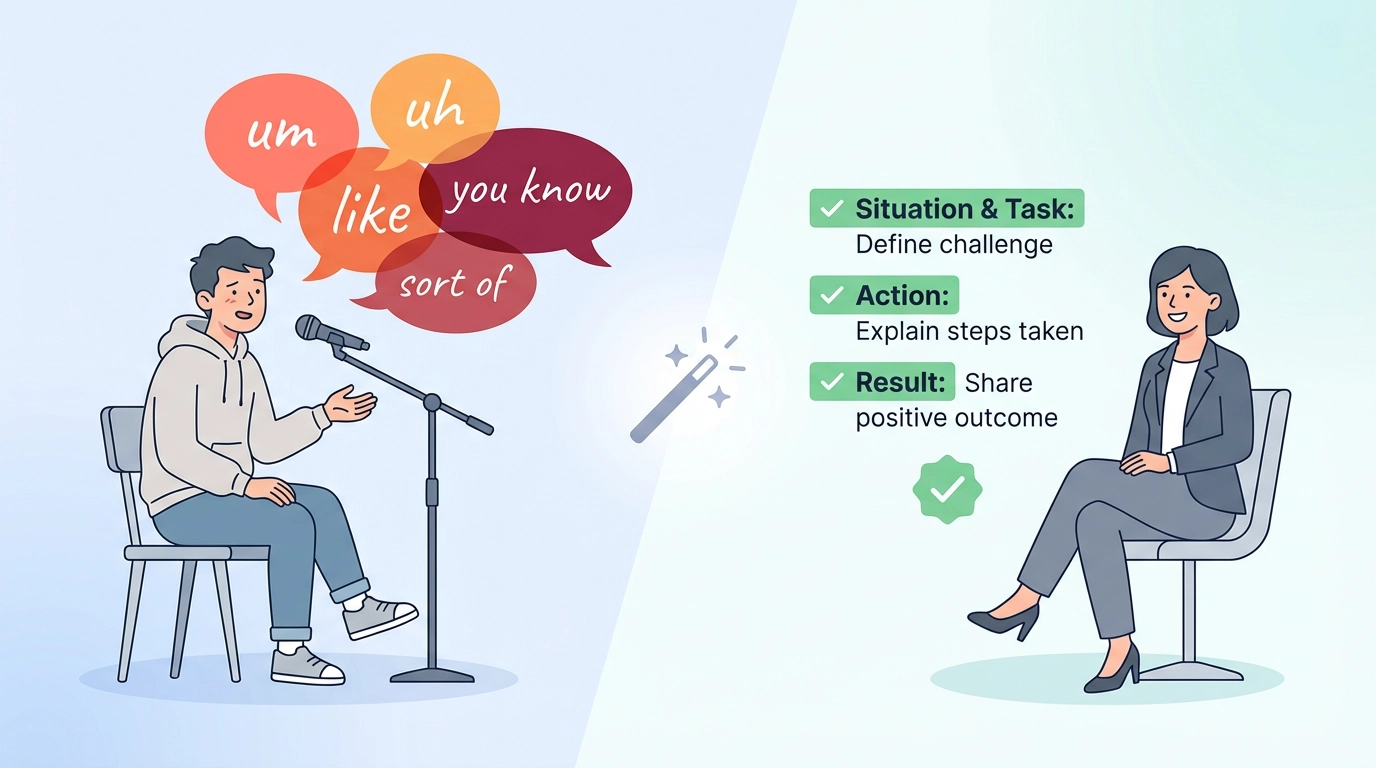
You're in a job interview. You know the answer. But what comes out is:
"So, um, basically, like, I was, you know, responsible for... um... managing a team of, I think it was about 15 people, and, um, we basically had to, like, deliver this project on a really tight deadline..."
Sound familiar? You're not alone. Filler words are the most common speech habit people don't notice until someone points them out — or until they lose a job offer they were qualified for.
Studies show interviewers form impressions within the first 90 seconds. And when those 90 seconds are filled with "um," "like," and "you know," the impression isn't great — no matter how strong your actual experience is.
Everyone tells you to stop saying um in interviews. Nobody tells you how. You can't hear yourself objectively while you're nervous and under pressure. You need a tool that captures what you actually say and shows you what it should sound like.
That's exactly what speech-to-text AI can do for you.
Why Filler Words in Job Interviews Cost You More Than You Think
Let's be honest about what filler words signal to an interviewer:
- Nervousness — "um" and "uh" spike when you're anxious
- Lack of preparation — rambling suggests you haven't thought through your answers
- Uncertainty — hedging phrases like "sort of" and "I think" make strong answers sound weak
- Poor communication skills — in roles that require client-facing work, this matters even more
And it's not just the obvious ones. Most people catch themselves saying "um" — but miss the hidden fillers that are just as damaging:
"Basically," "honestly," "like," "you know," "sort of," "I mean," "right," "at the end of the day."
These sound like real words, so your brain doesn't flag them. But an interviewer hears them stacking up.
Is it OK to say um in an interview?
An occasional "um" is completely natural — interviewers are human too. But there's a line. When filler words appear every few seconds, they become the thing the interviewer notices instead of your answer. Research shows that excessive filler words reduce perceived competence, even when the actual content is strong. Can filler words cost you a job? In a competitive interview, absolutely.
Here's the real problem: self-awareness alone doesn't fix this. You can't objectively analyze your own speech while you're under pressure. You need a feedback loop — something that captures what you actually said and shows you the cleaned-up, structured version so you can see the gap.
How to Practice Interview Answers Out Loud (And Actually See Your Mistakes)
Career coaches have given the same advice for decades: record yourself practicing interview answers and listen back. It's good advice — but it's incomplete.
Here's why the traditional method falls short:
- You record yourself answering a question
- You listen back and cringe at the filler words
- You hear that your answer rambles, but you can't isolate what specifically went wrong
- You don't get a corrected version — just the painful awareness that it wasn't great
- You try again, maybe slightly better, maybe not
- Repeat until frustrated
A recording without analysis is just a recording. You feel your mistakes but don't see the fix.
What you actually need is a way to speak your answer, then instantly see three things:
- What a polished version sounds like — your answer, restructured and professional
- What specifically you did wrong — your personal patterns identified
- How to deliver it better — a concrete tip, not generic advice
That's not transcription. That's coaching. And that's where speech to text for interview practice changes the game.
The breakthrough isn't turning speech into text — it's AI that doesn't just transcribe, it coaches. It takes your messy, filler-filled answer and transforms it into what a confident, prepared candidate would say. Then it tells you exactly what it fixed and how to improve your delivery.
Use Speech-to-Text AI to Remove Filler Words and Polish Your Answers
This is where a tool like VoxWrite comes in.
VoxWrite is a Chrome extension with a built-in "Prepare for Job Interview" template — it's not just a filler word counter tool or basic transcriber. It's an AI speech coach for interviews that works in three steps.
Step 1: Select the "Prepare for Job Interview" Template
One click. The template is powered by an expert interview coach AI that knows how to transform messy speech into compelling answers. You don't configure anything — it's ready to go.
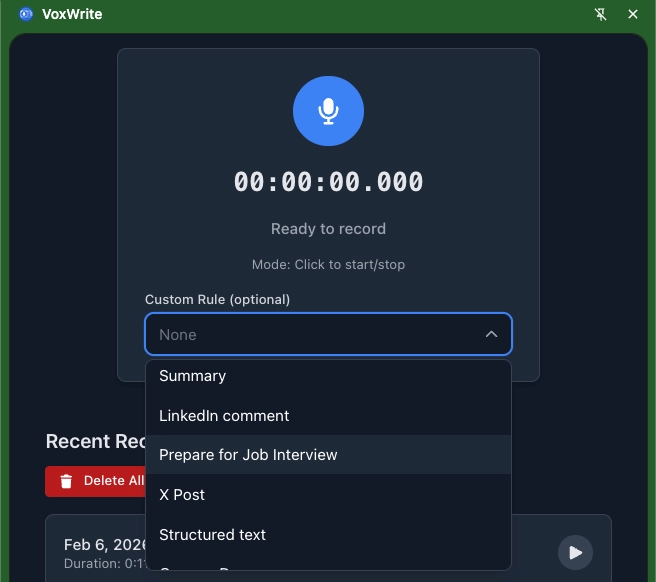
Step 2: Speak Your Answer Naturally
Click the mic and just talk. Ramble, pause, say "um" 15 times — it doesn't matter. Speak as if you're in the actual interview. Don't try to be perfect. The messier your raw speech, the more you'll learn from the output.
Step 3: Get Back Three Things — Not Just Clean Text
This is what makes VoxWrite different from basic speech-to-text. The template returns:
Polished Answer — Your rambling, filler-filled response restructured into a clear, professional answer. When relevant, it applies the STAR method (Situation, Task, Action, Result) — the gold standard for behavioral interview answers. It preserves YOUR experiences and YOUR words, organized the way a hiring manager wants to hear them. Targeted at 60-90 seconds when spoken (150-225 words) — the sweet spot for interview answers.
Key Improvements — 2-3 bullet points showing exactly what was changed and why. "Removed 9 filler words." "Restructured to lead with the result." "Condensed from 3 minutes to 90 seconds." You see your specific patterns so you can fix them next time.
Speaking Tip — One actionable delivery suggestion personalized to your answer. Not generic "speak slowly" advice — specific feedback like "Lead with the number — '15 people' — it immediately establishes scale and authority" or "Pause after your result statement to let the accomplishment land."
See It In Action
What you said (raw speech):
"So, um, basically, I was, like, responsible for, you know, managing a team of, I think it was about 15 people, and, um, we basically had to, like, deliver this project on a really tight deadline, and, honestly, it was kind of stressful but, um, we got it done, and, yeah, the client was happy I think."
What VoxWrite's template returns:
Polished Answer: "I led a team of 15 people on a project with an extremely tight deadline. I organized the workload into weekly sprints, held daily standups to catch blockers early, and personally managed the client relationship to keep expectations aligned. Despite the pressure, we delivered on time. The client renewed their contract, which was the strongest validation of our work."
Key Improvements:
- Removed 9 filler words ("um," "like," "basically," "you know," "honestly") and 3 false starts
- Restructured using STAR: added clear Action (sprints, standups, client management) instead of vague "we did it"
- Replaced weak ending ("yeah, the client was happy I think") with a strong, measurable result (contract renewal)
Speaking Tip: "Lead with the number — '15 people' — it immediately establishes scale and authority. Pause briefly after 'delivered on time' before the result statement to let the accomplishment land."
It's literally three steps. Select template, speak, get coached. Like having an interview prep expert available 24/7.
Important: The AI never invents experiences you didn't mention. If your answer lacks substance, it tells you what's missing ("Consider adding a specific metric" or "What was the measurable result?") rather than fabricating content. The polished answer is always authentically yours.
For non-native English speakers: VoxWrite supports 50+ languages. You can practice in your native language and get your answer back in professional English — learning natural phrasing and STAR structure by example.
On cost: You can bring your own AI API keys (OpenAI, Claude, Deepseek) and pay only for what you use — no subscription required. A practice session costs pennies.
Your 15-Minute Interview Practice Routine Using AI
Here's your day-before-interview practice plan. Fifteen minutes, five questions, three layers of coaching each round.
1. Pick 5 common interview questions:
- "Tell me about yourself"
- "Why should we hire you?"
- "Describe a challenge you overcame"
- "Where do you see yourself in 5 years?"
- "Why are you leaving your current role?"
2. Open VoxWrite and select the "Prepare for Job Interview" template
3. Answer the first question out loud — give yourself 2 minutes, don't overthink it. Just talk.
4. Read the Polished Answer — notice how VoxWrite restructured your rambling into STAR format. Where were your filler words? How did it turn your circular reasoning into a clear narrative?
5. Read the Key Improvements — these are your personal patterns. Do you always start with "So..."? Do you bury the result at the end instead of leading with impact? Do you ramble for 3 minutes when 90 seconds is enough?
6. Apply the Speaking Tip — practice the specific delivery suggestion. If it says "pause after your result statement," physically practice that pause.
7. Speak the same answer again — this time, try to naturally incorporate what you learned from all three outputs.
8. Compare attempt 1 vs attempt 2 — notice the gap closing.
9. Repeat for all 5 questions.
Why This Works
You're not just practicing speaking — you're getting personalized coaching each round. The Polished Answer shows you WHAT to say. The Key Improvements show you WHAT you're doing wrong. The Speaking Tip shows you HOW to deliver it. That's three layers of feedback most people only get from a paid career coach.
Pro tip: Save your polished outputs. They become your answer cheat sheet to review right before the actual interview — structured, concise, professional versions of YOUR real experiences.
Advanced: Once you're comfortable with the interview template, explore VoxWrite's other Smart Templates or create custom rules for specific interview styles — behavioral questions, case interviews, elevator pitches.
How to Articulate Better in Interviews: It's Not Just About Filler Words
Removing filler words is the first step. But how to speak more clearly in interviews goes deeper than that.
STAR Structure by Example
Most people know they should use the STAR method (Situation, Task, Action, Result) but struggle to apply it under pressure. VoxWrite's template automatically restructures your answers into STAR format — so you learn the pattern by seeing your own experiences organized this way. After a few practice rounds, you start thinking in STAR naturally.
Conciseness
The template targets 60-90 seconds per answer (150-225 words). See how your 3-minute ramble gets condensed to 90 seconds without losing substance. That's the target to aim for in the real interview.
Confidence Through Preparation
When you see your polished answers in writing, you internalize better phrasing. The speaking tips give you delivery techniques. The key improvements show you what to watch for. After five practice rounds, you're not just prepared — you're coached.
Integrity
The template never invents experiences you didn't mention. If your answer lacks substance, it tells you what's missing rather than fabricating content. This means the polished answer is always authentically yours — and you can speak it with confidence because it's real.
Multilingual Practice
Non-native speakers can speak in their comfortable language and get professionally written English answers — learning natural phrasing, vocabulary, and STAR structure by example. VoxWrite supports 50+ languages, making it an effective tool to practice interview answers in English regardless of your first language.
Start Speaking Like the Best Version of Yourself
Let's recap: Select the "Prepare for Job Interview" template. Speak naturally. Get a polished STAR-structured answer, specific feedback on what to improve, and a delivery tip. Three steps, three layers of coaching.
Most people practice interview answers by talking to a mirror. Some pay hundreds for a career coach. VoxWrite gives you expert-level feedback — your answer restructured, your mistakes identified, your delivery coached — for the cost of a few API calls.
VoxWrite is free to try on the Chrome Web Store. The "Prepare for Job Interview" template is ready to go — no setup needed. Give it 15 minutes before your next interview. You might be surprised how much better your answers sound after just a few rounds.
The goal isn't to sound robotic or rehearsed. It's to sound like the best, most articulate version of yourself — the version that shows up when you're confident, prepared, and not nervous. That version already exists. You just need the right practice tool to find it.
Frequently Asked Questions
Is it OK to say um in an interview?
An occasional "um" is completely natural and won't hurt you. But excessive filler words — saying um, uh, like, or you know every few seconds — signal nervousness and lack of preparation. Studies show interviewers form impressions within the first 90 seconds, and frequent fillers reduce your perceived competence. The goal isn't to eliminate every filler, but to reduce them enough that they don't distract from your actual answer.
Can filler words cost you a job?
Yes. Research shows that candidates who use excessive filler words are rated as less competent, less confident, and less prepared. In competitive interviews where multiple candidates are similarly qualified, how you communicate can be the deciding factor. Filler words make strong answers sound weak.
How do I practice for an interview by myself?
The most effective solo method is to speak your answers out loud and get feedback. Use a speech-to-text AI tool like VoxWrite with the "Prepare for Job Interview" template: speak your answer naturally, then get back a polished STAR-structured version, a list of specific improvements, and a personalized speaking tip. This gives you three layers of coaching — what good sounds like, what you did wrong, and how to deliver it better.
What are the most common filler words?
The most common filler words are: um, uh, like, you know, basically, honestly, sort of, I mean, right, and so. Many people also use filler phrases like "to be honest," "at the end of the day," and "if that makes sense." Some fillers are obvious (um, uh), but others like "basically" and "honestly" are harder to notice because they sound like real words.
How can I sound more confident in an interview?
Confidence in interviews comes from preparation and structure. Practice your answers out loud using the STAR method (Situation, Task, Action, Result) so your responses have a clear beginning, middle, and end. Use pauses instead of filler words — a deliberate pause sounds confident, while "um" sounds uncertain. Tools like VoxWrite help you see what confident, structured answers look like by transforming your raw speech into polished responses you can learn from.
Related Articles
- From Casual Speech to Professional Text: Using AI to Transform Your Tone
- Multilingual Voice Typing: Speak in Any Language, Write in Any Other
- The Complete Guide to Voice Typing for Faster Email Writing
- Voice Dictation for Accessibility: A Lifeline for Carpal Tunnel and RSI
About the Author: This guide was created by the VoxWrite team.
Last Updated: February 2026